

If you’ve ever refreshed an order dashboard five times waiting for a status to update, or watched a new hire copy the same customer info into three different systems, you already understand the real cost of a business that runs on manual effort. It’s not dramatic. It’s just slow, and slow adds up fast.
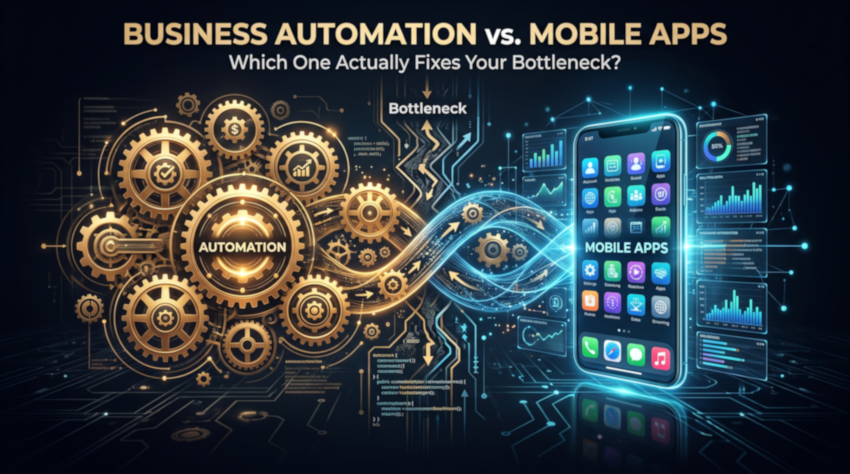
Two solutions tend to come up whenever business owners start looking for a fix: automating the backend, or building a mobile apps. They sound like they solve the same problem. They don’t. In this piece, we’ll break down what each one actually does, and where they genuinely make a difference.
What Business Automation Actually Does
Business automation isn’t a single piece of software — it’s a strategy for replacing manual, repeatable tasks with a system that performs them consistently, without a person having to remember to trigger each step.
An order comes in, and instead of someone manually forwarding it to fulfillment, accounting, and the customer’s inbox, the system routes it to all three the moment it’s placed. A lead fills out a form, and instead of sitting untouched for a day, it’s automatically scored and assigned to the right salesperson. Stock drops below a set threshold, and a reorder gets triggered before anyone has to notice the shelf is empty.
The value isn’t any single step. It’s that once the workflow is automated, it stops depending on someone’s memory or bandwidth on a busy day. A business automation company typically starts by mapping the actual workflow — where the delays happen, where information gets duplicated — before recommending any specific tool. Skip that step, and you risk automating a process that was inefficient to begin with, just faster.
What a Mobile App Actually Solves
A mobile app isn’t about efficiency in the same sense. It’s about access — putting the right information in front of the right person, at the exact moment and place they need it, without requiring a desk or a browser tab.
Think of it like the difference between a well-organized filing cabinet and someone who can hand you the exact document you need while you’re standing in the field. Automation is the filing cabinet — it keeps everything moving correctly behind the scenes. A mobile app is the hand-off — it gets that information to a technician, a driver, or a customer who isn’t anywhere near a desk.
A mobile app development company builds that interface to plug directly into the systems already running the business, rather than existing as a disconnected add-on. That distinction matters more than it sounds — an app that isn’t wired into the same backend as everything else just becomes another manual step someone has to reconcile later.
Where Each One Actually Gets Used
1. Field Service Businesses
A technician heading to a job site needs the customer’s history, the service notes, and parts availability — often standing somewhere with no signal at all. Automation handles the backend: scheduling the job, updating inventory, generating the invoice once the work is marked complete. The mobile app is what puts all of that in the technician’s hand, live, without a phone call back to the office.
2. E-Commerce and Retail
A customer expects their order confirmation instantly, their shipping update automatically, and the ability to check a loyalty balance without hunting for a login page. Automation handles the order routing and inventory sync in the background. The app is the storefront in their pocket — the direct line into that same system.
3. Delivery and Logistics
A dispatcher can’t manually reroute twenty drivers every time traffic shifts. Automated routing recalculates in real time. But that update is worthless unless it reaches the driver instantly — which is exactly what the mobile layer is built to do.
In each case, the two aren’t competing solutions. They’re solving different halves of the same problem: automation keeps the system accurate behind the scenes, and the app puts that accuracy directly into someone’s hands.
Why the Two Work Best Together
A common mistake is treating automation and a mobile app as separate projects, built at different times by different teams, for different reasons. That usually creates two systems that don’t fully agree with each other — and someone ends up reconciling the gap manually, which defeats the entire purpose.
The stronger approach starts with the workflow itself: map how information actually needs to move, from a customer’s phone into inventory, into fulfillment, and back out as confirmation, then decide which parts run automatically in the background and which parts need a direct interface someone can hold. Built this way, business automation and the mobile layer function as one connected system, not two.
Where This Is Heading
As more of a business’s daily operations move away from desks and into the field, the line between “backend system” and “customer-facing app” keeps getting thinner. Automation is what makes a business’s data trustworthy in real time. Mobile access is what makes that data useful to the people who actually need it, wherever they happen to be standing.
Neither one replaces the other. The businesses getting the most out of both aren’t choosing between automation and an app — they’re building the two to run as a single, connected system from the start.
